
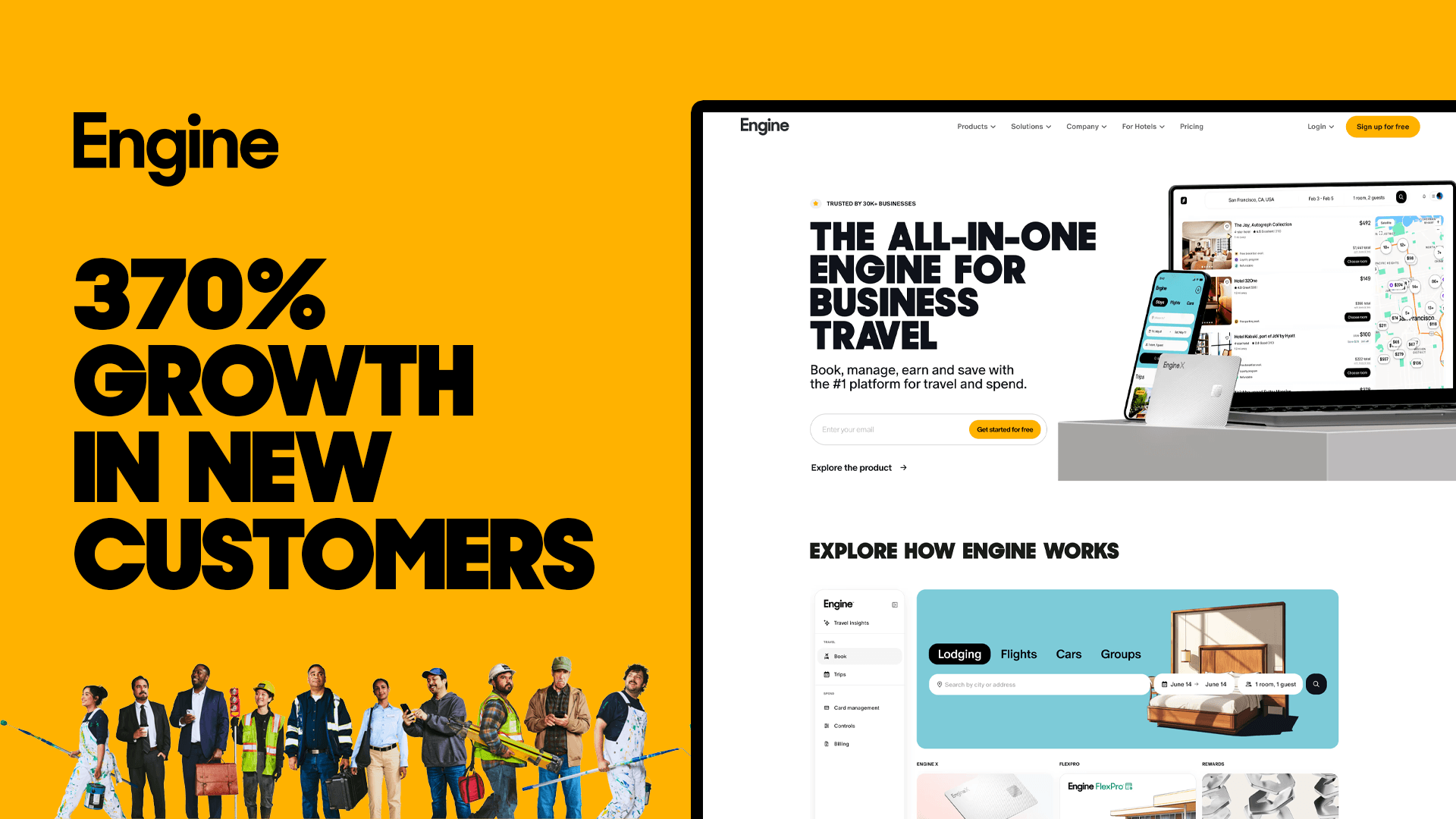
Engine, is a free SaaS travel management platform that companies use to book hotels, flights, and rental cars at discounted rates and consolidate their entire travel book of business with one provider.
Background
I joined Engine's growth marketing team in May of 2025, and what drew me in was a shape I recognized. Engine had a freemium product, real momentum, and a volume-rewarding business model. It reminded me of what I had just spent my Webflow years working on. I had seen what happens when you take a free product with genuine demand behind it and put a disciplined acquisition engine underneath it, and I wanted to do it again.
Here is how I brought paid search in-house and more than tripled new customer growth.
Inheriting Work from Two Agencies
When I arrived, Engine was working with two outside agencies. One handled the B2B side and the other handled Engine Groups on the B2C side. Both were competent. My responsibility was all things paid search and programmatic. Everything lived on Google properties: search, video, Demand Gen, keyword research, ad copy, and connected TV and display. I inherited it all from both agencies at once.
The mandate was to find out whether an in-house operator could outperform two agencies.
“Anyone can cut CAC by turning off spend. Cutting CAC while leads and bookings climb means the mix is actually getting better.”
Outperforming the Agencies, Month Over Month
I did not try to rebuild everything in week one. I set a single goal for my first quarter: move leads up and cost down in the same month, then do it again the next month.
It worked immediately, and it kept working. In my first full month running the accounts, both leads and confirmed bookings climbed more than 25% over the prior month. Then customer acquisition cost (CAC) fell by more than 25% for three consecutive months, and it fell while volume kept rising, which is the part that matters. Anyone can cut CAC by turning off spend. Cutting CAC while leads and bookings climb means the mix is improving.
By the time I had a full year of my own work to compare against the agencies' baseline, the gap was not subtle. Comparing the first five months of 2026 against the same five months of 2025 on the Groups side:
- New customers grew more than 370% YoY
- Bookings grew more than 120% YoY
- Leads grew more than 80% YoY
- Gross booking value (GBV) from paid search grew 520% YoY
- Customer acquisition cost (CAC) decreased 65% YoY
- Cost per booking (CPL) decreased nearly 30% YoY
- The rate at which a lead converted into a paying customer more than doubled
Spend went up too, by a bit more than half. I want to be straightforward about that, because a growth number without a spend number is a magic trick. But new customers grew roughly six times faster than the budget did. That ratio is the whole story. The budget did not buy the growth. The structure did.
Setting a Range for Profitable Scale
Cutting costs is the first half. It is also the half that runs out. Once CPL and CAC are down to a level the business can live with, the question shifts from "where do I cut" to "where do I scale."
I set a range anchored to customer lifetime value (CLTV), with a lower and upper limit. The rule that follows is mechanical. If an ad group is acquiring customers meaningfully below the upper limit, you keep adding budget to it. You keep adding until the cost approaches that ceiling, and then you stop, because past that point you are buying customers the business will lose money on. No debate, no gut feel, no arguing with the person who wants to scale a campaign because it feels like it is working.
This is what made the growth durable, not a single good quarter. I always had a defensible answer to where the next dollar should go and where it should not.
Rewriting Every Ad to Match the Search
One level below keywords that most accounts ignore is the ad itself.
The temptation with paid ads is to write a handful of good ones and serve them everywhere. I do the opposite. Every ad group gets an A/B test running, and I judge the winner by click-through rate, CPL, and CAC, not by which one I liked writing.
More importantly, I rewrite every ad to match the search terms customers are actually typing. Even across five campaigns with similar offers, the ads shouldn't be similar, because the searches aren't. Someone typing a query about booking rooms for a wedding party isn't in the same headspace as someone booking rooms for a construction crew, and an ad that speaks to both speaks to neither.
When an ad was bringing in expensive leads, I did not just pause it. I asked what was wrong with the framing, whether the CTR could be lifted, and whether the message actually matched the landing page people were arriving on. Message match between the ad and the page is where a lot of paid budget quietly dies
Building My Own AI Models Alongside Google's
I also used AI for budget projection: given a fixed monthly budget and a known set of efficient campaigns, how far can this money actually go?
The key detail is that I didn't rely on Google's AI alone. Google has excellent modeling, but it has an institutional bias: its answer to almost any problem is to increase the budget. That is not a conspiracy; it is just what the incentives produce.
So I ran my own models in parallel using third-party tools like Claude, and used them to check Google's recommendations. When both agreed, I moved with confidence. When they disagreed, that disagreement was itself the signal, and it usually pointed to something worth investigating. This is also how I got much more aggressive with negative keywords, systematically cutting terms that were consuming budget without converting and redirecting that money to what was working.
Two models holding each other accountable is a better system than one model you cannot argue with.
What the Playbook Proved
The results at Engine came from a methodology, not a trick. Slice the data far enough down to see what is actually happening. Cut the waste that the campaign view hides. Anchor your scaling ceiling to lifetime value instead of to a feeling. Write every ad to the search that triggered it, and make the page match the ad. Use AI as a second opinion rather than an oracle.
By the end of my time there, paid search was producing the strongest performance in the company's history for that channel, at a fraction of the acquisition cost the agencies had been running.